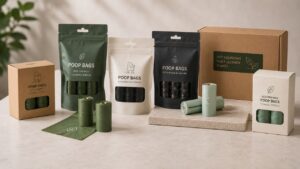
Dog poop bag specifications can look simple on a quotation sheet: size, thickness, bags per roll, and a few construction details. In practice, these choices shape how the finished product feels, performs, and fits its intended use.
For B2B buyers, the goal is not to maximize every number. It is to define a specification that matches the target market, expected performance, dispenser format, and price position.
If material selection is still open, our eco-friendly dog poop bag sourcing guide provides a broader overview of the main material routes.
Start With the Bag Size
Dog poop bag size should reflect how the finished product will actually be used.
Width and length affect usable space, material consumption, and the overall feel of the bag. A larger format gives users more room, while reducing dimensions can help keep the product compact.
The point is not to copy a competitor’s dimensions without checking whether they suit your own product. A bag that looks efficient on paper may feel too small in daily use, while unnecessary length or width adds material without necessarily improving the experience.
For handle bags, confirm how the dimensions are measured. Buyers should know whether the stated length includes the handle section or only the main bag body. Two products with the same quoted length may not provide the same usable space if the measuring method differs.
Choose Thickness Based on Required Performance
Dog poop bag thickness affects strength, puncture resistance, material feel, barrier performance, material consumption, and cost.
But thicker is not automatically better.
A value-focused retail product may not need the same specification as a bag positioned around a heavier feel or higher performance expectations. The more useful question is: what does the product need to deliver in normal use?
Thickness should also be considered together with bag dimensions and material type. The micron figure alone does not describe the complete product.
Set Bags per Roll With the Finished Roll in Mind
Bags per roll is more than a number printed on the retail box.
Private label projects may use 10, 15, 20, or other counts per roll depending on the intended format. Increasing the number of bags can increase the finished roll diameter, which may affect dispenser fit and the space available inside the retail pack.
Rolls per pack should be considered in the same way. An 8-roll and a 16-roll format create different total bag counts and different retail offers.
The chosen roll count should fit the product concept, pack format, and intended use rather than simply copy another product.
Handle or Non-Handle?
Handle bags give users a built-in way to tie and carry the bag, while non-handle bags use a flat-bag format.
From a sourcing perspective, the construction needs to be defined clearly before sampling. For handle bags, the main bag body and handle area should be understood separately so the approved sample matches the intended usable size.
Core or Coreless?
Dog poop bag rolls can be produced with a paper core or as a coreless roll.
A paper core provides a defined centre structure. A coreless format removes that additional component.
The choice should be based on the finished roll structure, dispenser fit, and packing requirements rather than on an assumption that one format is always better.
Check Perforation, Opening, Color and Printing on Samples
Some small specification details become very noticeable once the product is in use.
Perforation is a good example. One bag should separate cleanly without tearing into the next bag, and this is better checked on a physical sample than judged from a quotation sheet.
Opening ease matters for the same reason. A strong bag can still create a poor user experience if customers struggle to identify or separate the opening.
Printing should also be defined clearly. Some private label dog poop bags carry a logo or other information on the bag, while others remain plain and place the branding on the retail packaging.
Where customization is required, bag color and print color should be confirmed separately. “Green bag” or “custom print” is not specific enough for final approval.
Scented or Unscented?
Scent should be treated as a product and brand decision, not as an automatic upgrade.
Some projects require a scented version; others specifically need unscented bags. The choice should not be assumed from the market or sales channel alone.
Confirming it before sampling ensures that the approved sample represents the intended final product.
Check Compatibility Before Finalizing the Specification
Dog poop bag specifications work best when these details are checked together rather than treated as separate decisions.
Changing the thickness or number of bags per roll may change the finished roll diameter. If that happens, dispenser fit and available packaging space may need to be checked again.

This is where specifications begin to connect with the next stage of a private label project. Our private label dog poop bag guide covers packaging, MOQ, samples, and production follow-up in more detail.
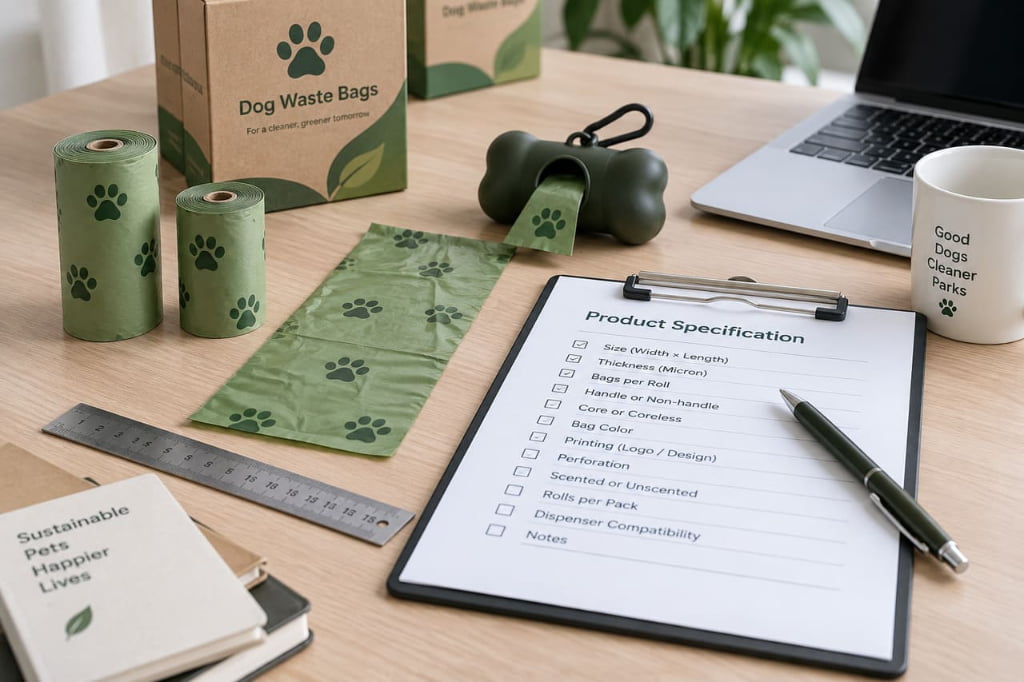
Dog Poop Bag Specifications Checklist
Before approving a final dog poop bag specification, confirm:
- Bag width and length
- How handle-bag dimensions are measured, if applicable
- Thickness
- Handle or non-handle
- Bags per roll
- Core or coreless
- Bag color and printing requirements
- Perforation and opening
- Scented or unscented
- Rolls per retail pack
- Dispenser compatibility
The purpose is simple: make sure the buyer and supplier are discussing the same finished product.
Final Thoughts
A good dog poop bag specification is not defined by the largest size, highest thickness, or most bags per roll.
It is a combination that delivers the required performance and user experience while remaining practical for the intended product format and price position.
If you are developing a private label dog poop bag project, sharing your target market, preferred size, thickness, bags per roll, and roll format gives us a useful starting point.