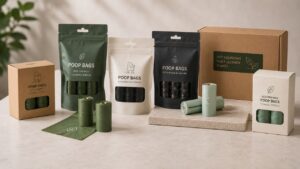
Dog poop bag quality control becomes much easier when there is something clear to compare against.
By the time bulk production is ready, the main decisions should already have been approved: product specifications, sample, printing, roll configuration, and packaging. A pre-shipment check is therefore less about deciding what the product should be and more about confirming that the finished goods match the agreed version.
If your project is still at the specification or sampling stage, those decisions should be finalized first. This checklist becomes most useful once bulk production is ready for review.
For B2B buyers, effective dog poop bag quality control starts with a clear reference point rather than a long inspection checklist.
Start With the Approved Specification and Sample
Before inspecting bulk production, gather the final references used for approval.
Depending on the project, these may include:
- Confirmed product specifications
- Approved physical sample
- Final artwork
- Approved retail packaging
- Roll and pack configuration
Without a clear reference, comments such as “too thin,” “wrong green,” or “roll looks too large” can quickly become subjective.
The approved sample is particularly useful because it gives both buyer and supplier a physical reference for the finished product. Our private label dog poop bag guide explains how samples fit into the wider development process.
Measure Bag Dimensions and Thickness
Check bulk production against the confirmed dimensions and thickness.
Do not rely on a single bag. Measure several samples and, where practical, take them from different parts of the finished order.
The purpose is straightforward: confirm that the goods being shipped match the specification that was approved.
For buyers who are still defining these parameters, our dog poop bag specifications guide covers size, thickness, roll count, and other product details in more depth.
Inspect Seals and Bag Condition
Correct dimensions do not help much if the bag has weak seals or visible film defects.
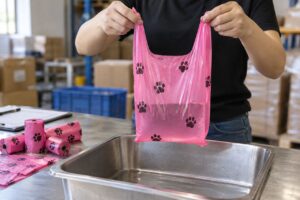
Look for issues such as:
- Incomplete seals
- Weak or uneven sealed areas
- Holes or damaged film
- Irregular edges
- Repeated defects in the same area
Handle a few bags rather than checking only their appearance.
A simple water-leak check on selected bags can also help reveal pinholes or weak seals that may not be obvious during visual inspection.
Selected bags can also be handled and pulled gently to check for obvious weakness around sealed areas. If tensile or tear strength is a formal project requirement, use the agreed test method rather than relying on a manual check.
If several samples show the same problem, it is worth reviewing before shipment.
Test Several Perforations in Sequence
Perforation is better checked across several consecutive bags than on a single tear line.
Pull a number of bags from the roll and confirm that:
- Each bag separates at the intended perforation
- The next bag remains intact
- The perforation is positioned consistently
- The bag opening does not show obvious production defects
This type of problem can be difficult to judge from a few production photos. Checking several bags from an actual roll gives a more useful picture of how the product will behave in use.
Check Roll Winding and Bag Count
The finished roll should match the approved configuration.
Check:
- Bags per roll
- Core or coreless format
- Roll winding
- Roll shape
- Consistency between sampled rolls
A roll that is unusually loose, distorted, or noticeably different from the rest deserves another look.
For selected rolls, count the bags rather than assuming the quantity is correct from the outside. The same applies to rolls per retail pack.
Compare Printing, Color and Appearance With the Approved Version
Printed or customized dog waste bags should be compared directly with the approved reference.
Check for:
- Missing or unclear printing
- Obvious print-position shifts
- Blurred or incomplete areas
- Noticeable color inconsistency
- Differences from the approved sample or agreed color reference
Where color matters, compare physical production with the agreed reference rather than relying on a screen image or memory.
The aim is not to create a new color standard during inspection. It is to check whether production follows the version already approved.
Check Retail Packaging as a Finished Pack
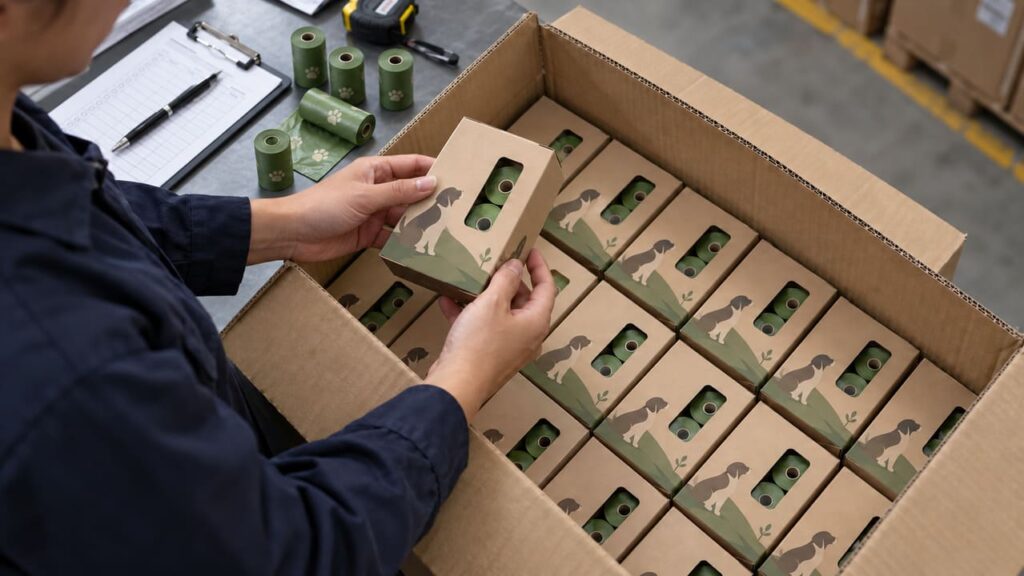
Retail packaging should be checked with the actual product inside it.
Confirm:
- Correct artwork version
- Correct product inside the pack
- Correct number of rolls
- Labels and barcodes where required
- Retail box or pack condition
This becomes particularly important when a project has several SKUs, colors, or packaging versions. A correct bag packed into the wrong box is still a shipment problem.
At this stage, the packaging design should already be finished. The QC question is simply whether the produced pack matches the approved version.
Check Master Cartons and Outer Markings
A short carton-level check can catch mistakes that may otherwise appear only after delivery.
Confirm:
- Correct carton markings
- Correct quantity per carton
- Correct SKU or product version
- No obvious carton damage
- No mixed or incorrectly packed products
There is no need to turn this into a full logistics audit. The purpose is to make sure the finished order is packed and identified correctly.
Record Any Problems Clearly
When an issue is found, a vague message such as “There is a quality problem” does not give enough information for useful follow-up.
A better record includes:
- What the issue is
- Where it was found
- How many inspected samples showed the issue
- Photos or video
- The approved specification or sample used for comparison
For photos, it can help to include both a close-up of the defect and a wider image showing which roll, retail pack, or carton it came from.
It is also useful to separate functional problems from cosmetic differences, since they may require different follow-up depending on the agreed quality requirements. A leaking bag, weak seal, incorrect count, or unusable perforation is a different type of issue from a minor visual variation.
Clear documentation makes it easier to decide what should happen next — whether that means rechecking, sorting, reworking, replacing affected goods, or discussing the result with the buyer.
Dog Poop Bag Quality Control Checklist
A practical pre-shipment check may include:
- Bag dimensions
- Thickness
- Seals and film condition
- Basic leak check
- Perforation and opening
- Roll winding
- Bags per roll
- Core or coreless format
- Color and printing
- Rolls per retail pack
- Packaging version and condition
- Carton quantity and markings
The exact checklist can vary by project. What matters is that the finished goods are checked against the agreed product, not against a general idea of what a dog poop bag should look like.
Final Thoughts
Pre-shipment quality control is most useful when the buyer and supplier already have clear references in place.
Confirmed specifications, an approved sample, final artwork, and the correct packaging version make it much easier to identify real differences in bulk production.
For larger orders or projects with more formal quality requirements, buyers may also use an agreed sampling plan or a third-party inspection service. The appropriate level of inspection depends on the project and the buyer’s own quality requirements.
For private label dog poop bag projects, a structured pre-shipment check can help identify avoidable problems before the goods leave the supplier.