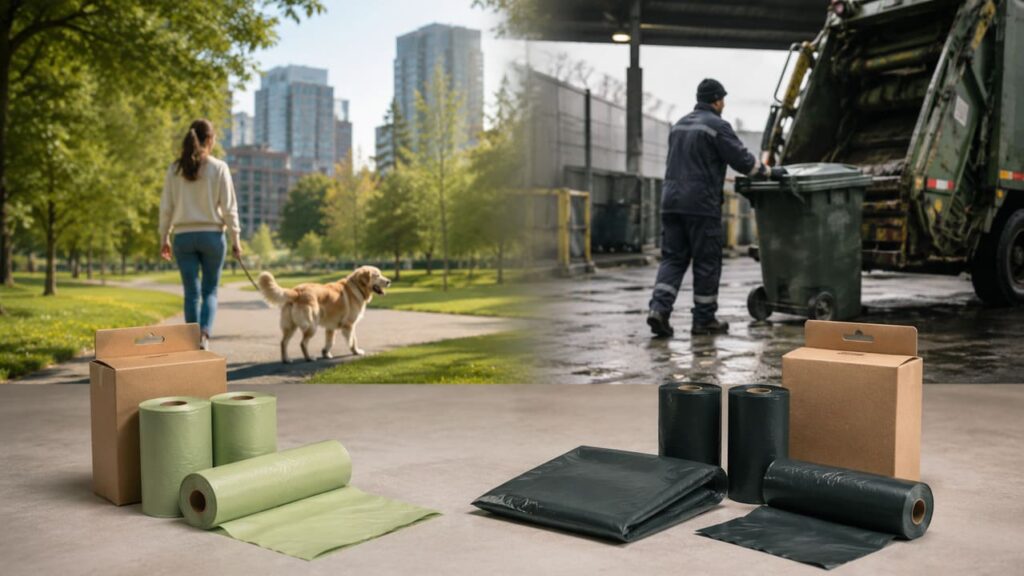
When buyers compare compostable vs biodegradable dog poop bags, the terminology may seem straightforward. In practice, it often is not.
In private label projects, terms such as compostable, biodegradable, bio-based, and eco-friendly are sometimes used as if they mean the same thing. They do not.
That matters because the wording used at the sourcing stage can affect the material offered, product cost, supporting documentation, and eventually the claims printed on the packaging.
Before requesting samples or quotations, buyers should first clarify one question:
What does the product actually need to claim in the target market?
Quick Distinction
Biodegradable is a broad description. By itself, it does not tell a buyer under what conditions a product breaks down, how long it takes, or what documentation supports the claim.
Compostable is more specific and is normally connected to defined composting conditions, applicable standards, testing, and supporting documentation.
For B2B sourcing, that difference matters more than the terminology itself.
Compostable vs Biodegradable Dog Poop Bags: What Is the Difference?
A biodegradable material can be broken down through biological processes, but the word biodegradable alone leaves several important questions unanswered.
For example:
- Under what conditions does degradation take place?
- What timeframe is involved?
- Which testing method or standard applies?
- Does the documentation cover the raw material or the finished product?
Compostable claims are more specific.
Depending on the product and target market, buyers may encounter standards such as EN 13432 in Europe or ASTM D6400 in North America. The applicable requirement should always be checked for the exact product, market, and claim being used.
Buyers sourcing compostable dog poop bags should therefore look beyond the material name and ask what documentation supports the product being offered.
Why Claims and Documentation Matter
For a private label buyer, choosing the material is only part of the project.
The other part is deciding what the brand intends to say about that material.
These statements, for example, are not interchangeable:
- made with recycled plastic
- bio-based
- biodegradable
- compostable
- certified compostable
The wording on the packaging should match the actual product and the documentation available for the project.
This leads to one of the most useful questions a buyer can ask:
Does the certificate or test report apply to the raw material, the formulation, or the finished bag?
The name of a standard alone is not enough.
Where certification or supporting documents are required, Xinrui can check what documentation is available from the relevant production facility or upstream material supplier. Any certificate should be understood according to its actual holder and scope; a factory-held certificate should not be presented as a certificate issued to Xinrui.
That distinction is especially important before private label artwork is approved.
Bio-Based Does Not Mean Compostable
Bio-based and compostable describe different aspects of a material.
Bio-based relates to the source of the material or its carbon content.
Compostable relates to how a product is intended to break down under defined composting conditions.
For example, Bio-PE dog poop bags provide a bio-based, low-carbon material direction while still behaving like polyethylene in use.
They should not automatically be described as compostable.
For buyers, the first question therefore should not be:
“Which material sounds greener?”
It should be:
“Which material supports the positioning and claims required for this project?”
What Buyers Should Check Before Ordering
Before approving a compostable dog poop bag project, buyers should review the commercial specification just as carefully as the sustainability claim.
A practical sourcing checklist includes:
- Target market — Where will the finished product be sold?
- Required claim — Is certified compostability genuinely required?
- Standards and documentation — Which standard is relevant, and what exactly does the available certificate or test report cover?
- Bag specification — Size, thickness, color, roll count and core format.
- Performance — Seal strength, tear resistance, leakage resistance and perforation.
- Storage — Are there specific shelf-life or storage requirements?
- Packaging wording — Does the printed claim accurately reflect the product and available documentation?
Most importantly, buyers should approve the actual finished sample, not only the material concept.
A sustainability claim does not replace normal product evaluation.

The bag still needs to open easily, separate cleanly from the roll, hold waste reliably, and meet the agreed specification.
Why Compostable Projects Can Cost More
Compostable materials can be a good fit when compostability is an important part of the product strategy.
However, the commercial structure may be different from recycled or conventional PE projects.
Cost can be influenced by factors such as specialty materials, testing or certification requirements, storage considerations, packaging claims, and project specifications.
For certification-driven or premium product lines, that additional cost may be justified.
For other projects, the buyer may discover that certified compostability was never actually a requirement.
That is why it is worth defining the objective before comparing quotations.
If the goal is simply to develop a more sustainable dog waste bag range, compostable is not the only material route available.
When Should Buyers Compare Other Materials?
If certified compostability is a genuine project requirement, a compostable formulation may be the right direction.
If it is not, buyers may want to compare other approaches before selecting a material.
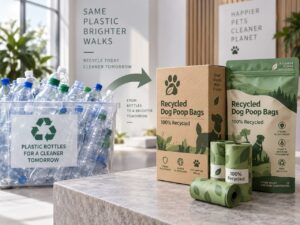
100% Recycled dog poop bags focus on giving post-consumer plastic another useful application and provide a clear recycled-content position.
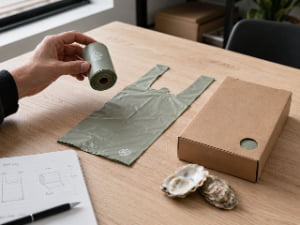
Oyster Shell + Recycled dog poop bags combine recycled plastic with a waste-derived oyster shell mineral component. The formulation gives two existing material streams another useful application and uses no mined limestone-derived CaCO₃ filler. For private label buyers, this creates a less conventional recycled-based material direction without requiring a compostable claim.
Bio-PE dog poop bags provide another option when low-carbon positioning is more important to the project than compostability.
None of these materials is automatically better.
They solve different sourcing and positioning requirements.
For a broader comparison, see our guide on how to choose eco-friendly dog poop bags for wholesale and private label projects.
Five Questions to Ask Before Sampling
Buyers do not need a long technical questionnaire to start a conversation.
Five questions will usually make the project much clearer:
- What material formulation are you proposing for the claim I need?
- What documentation is available, who holds it, and what exactly does it cover?
- Is the finished bag intended to carry a compostable claim?
- What performance specifications should we confirm during sampling?
- Are there other material options if certified compostability is not required?
The answers should be specific.
If every question is answered only with terms such as “eco-friendly,” “green,” or “biodegradable,” the project probably needs more clarification before moving forward.
Final Thoughts
For buyers comparing compostable vs biodegradable dog poop bags, the difference goes beyond terminology.
For B2B buyers, it can affect material selection, documentation, packaging claims, cost, and product positioning.
A good sourcing process starts by defining the required claim first.
If certified compostability is essential, build the project around that requirement and verify the relevant documentation.
If the actual goal is recycled content, a differentiated material story, or low-carbon positioning, it may be worth comparing other material routes before approving the sample.
Not Sure Which Material Direction Fits Your Project?
Share your target market, required product claims, bag specification, packaging format, and target price range.
We can help you compare suitable material directions before moving into sampling.